Albert Snid–San Antonio Activist
Talkin’ Union, the PHIT documentary about women in the Texas Labor Movement was produced in the late 70s. The story is still relevant today.
Alberta Snid and Charlotte Graham were the stars of Talkin’ Union.
People’s History in Texas Substack is a reader-supported publication. To receive new posts and support my work, consider becoming a free or paid subscriber.
Charlotte Graham worked in the garment industry in Dallas and Alberta Snid worked in the pecan shelling sheds in San Antonio.
After their separate labor strike stories, both Charlotte and Alberta went on to spend a life fighting for basic rights in Texas. Here is Charlotte’s story.
This is the mostly untold story of Alberta Snid.
Just to remind folks— the Pecan Shellers Strike was a mass strike in 1938 that captured national attention. 12000 workers, mostly Mexican American women, overcame the opposition of the pecan shelling industry, the police, and the San Antonio political establishment to form a union and to gain a wage increase.
Emma Tenayuca, impassioned and articulate and charismatic, became the face of that strike and a Texas labor icon.
Emma Tenayuca was not a pecan sheller.
Aberta Snid was a pecan sheller, working in the pecan sheds in atrocious conditions for miserable pay.
In 1938, Alberta Snid was 16 years old. Emma Tenayuca, the leader of the strike, wasn’t much older.
Alberta’s mother was a block organizer and a vice-president in her organizing committee Both mother and daughter spent at least one night in jail. .
Alberta, in her interview, described a life of proud poverty in San Antonio. She had to quit school in the Depression and follow her folks on the migrant harvesting trail. She described abysmal conditions in the fields. But they did what they had to do.
Shelling pecans, although the family didn’t have to camp out in primitive conditions, wasn’t a barrel of laughs either.
“Fifty, sixty persons all in one place, you know, sitting side by side. Really sitting on wooden benches—not chairs—wooden benches, makeshift benches and we were there for nine, ten hours a day. It was a very bad situation. Of course, we had no sanitary conditions at all, no sanitary conditions… period. Oh, I mean the places where the pecans were being shelled, that area had to be cleaned.”

It wasn’t sanitary, the bathrooms were a horror, and the work wasn’t exactly lucrative either.
“The best I can remember was five cents a pound and from there it went down, and I mean all the way down. To the point where some people were not getting paid with money any more, but with beans and potatoes and staples, you know, rice, shortening, salt, baking powder, coffee and I don’t mean that there was a whole bunch of it, you know, just a pound of this and a pound of that. Maybe five pounds of beans, a sack of flour, a twenty-five pound sack of flour, maybe ten pound sack of flour, whichever they felt like giving you. My mother never allowed that though. Oh no, she fought for her money. If it was a dollar she was gonna fight for it and she was gonna get it.”
Alberta learned that lesson. She fought for dignity. All of her life. Her mother demanded what was owed to her. And helped others.
Her father was also poor but proud. “He told us to ‘bow to no one.’”
The Pecan Shellers Union won the strike. The got a small increase, but then the industry mechanized and pecans were no longer hand-shelled. Be sure to watch the full documentary here.
Some people criticize the pecan shellers strike and say that it had no lasting impact. Alberta Snid, who walked that picket line and spent that night in jail, is proud of the Pecan Shellers Strike. She believes that it was successful in what counted.
“I think we learned, we learned that through organization we could do something. Maybe we didn’t win that much as far as money was concerned, but we learned that being united is power. A single person cannot do anything, alone we cannot do anything. People are power. Yes, I think we learned a whole lot.”
People are power! Indeed!
The organizers that Alberta Snid remembered were Emma Tenayuca and Homer Brooks, George and Latane Lambert, J. Austln Beasley, and Emllo Clemente. Homer Brooks was married to Emma Tenayuca and was head of the Texas chapter of the Communist Party.
George Lambert was a member of the Communist Party. Latane Lambert was a member of the Socialist Party.
“That’s when I met Emma Tenayuca and the rest. I don’t think we knew anything about what communlsm was, so I don’t think there was very much effect, good or bad.”
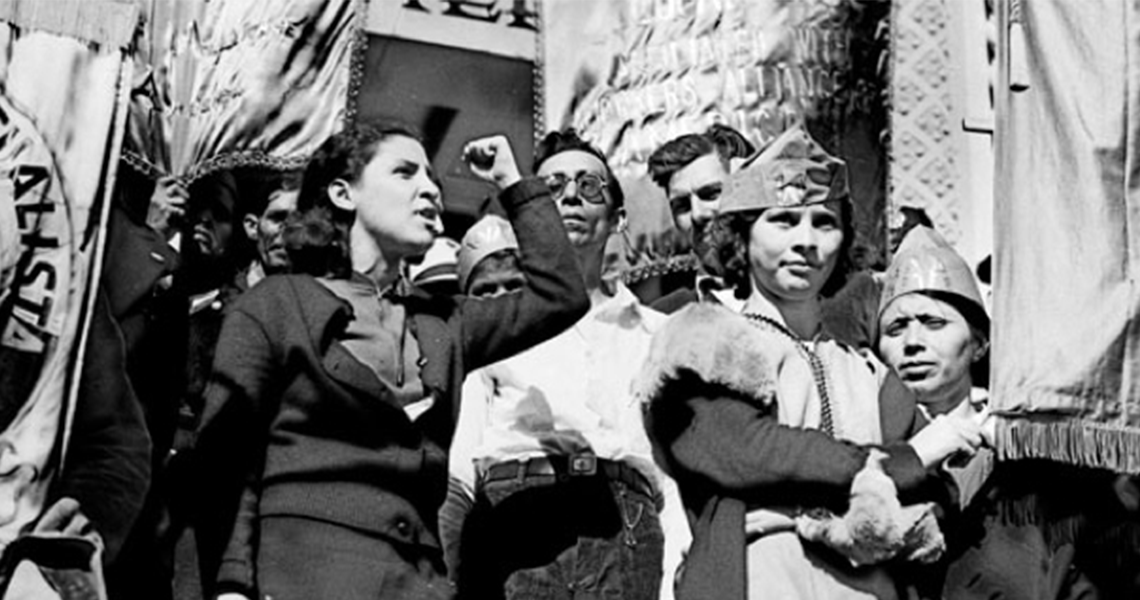
“We only knew one thing–that there was a woman that was organizing people for this issue, and the issue was that we were hungry, and something had to be done about lt.”
Alberta went on to a life of advocacy. In the 1960s and 70s, she was part of the Edgewood School lawsuit that sued the public education system in Texas for discriminatory provision of education.
Alberta was interviewed for Talkin’ Union in 1976, while she was in the middle of the Edgewood lawsuit.
Alberta Snid in 1968 had three children in Edgewood school district. 400 Edgewood High School students walked out complaining about the conditions their learning environment— crumbling and dilapidated buildings, outdated material, ill-paid staff and teachers without credentials. They complained that no college prep courses were offered. They complained that there was no toilet paper in the bathrooms.
The lawsuit blamed the Texas public school situation on a taxing mechanism that relied on local property taxes. Rich districts, with high property values, had lots of money. Poor districts, with low property values, had no money to build and to maintain the educational system. The Edgewood lawsuit said that was discriminatory and unconstitutional.
The case went to the Supreme Court, which rejected the lawsuit. Why you might ask? The Supreme Court said there is no constitutional right to education in the United States.
But there is a constitutional right to education in the Texas state constitution. Edgewood refiled in the Texas State court system and won. It took 20 years.
And the taxing mechanism was changed to the current one. One could argue that another lawsuit might be in order.
Alberta Snid was one of the original complainants. She was one of the prime movers in the organization. She wasn’t listed first on the complaint because of her married last name. Not Hispanic enough. Snid was actually shortened from Sneed. She married an African American, which she had to keep quiet, because miscegenation was illegal in those days.
She also worked at a community center where she advocated for women’s rights. Today this is called intersectionality.
For Alberta Snid, it was just life in San Antonio.
——————————————————————————-
Emma Tenayuca was the charismatic leader of the Pecan Shellers. She paid the price. She was driven out of the state, and had to lie low for decades.
Alberta Snid was a home grown activist and a grass roots organizer who battled consistently all her life for her rights. She deserves to be recognized as such.
They both deserve monuments. And PHIT, as soon as we win the big lottery, is going to construct them.